TRADING CAPITAL & FINANCIAL WELLBEING
How to build trading capital without borrowing money
You have been learning a strategy, practising on historical charts and thinking about opening a trading account. Then comes a practical question: “Where will the money come from?” It can feel frustrating to learn without spare money to use. But rushing to fund an account can create a bigger problem than waiting. Never borrow money to fund speculative trading. That includes friends, family, credit cards and other credit facilities. If a trade loses, the repayment obligation remains.
First, check whether you have money available to risk
Money left after payday is not necessarily spare money. Some may already be needed for rent, food, transport, annual bills, debt repayments or family commitments. Look at several months of actual spending, including expenses that do not arrive every month, before setting any trading target.
Keep emergency savings separate. An unexpected repair or interruption to income should not force you to withdraw from an open trading position. The FCA encourages people to address short-term debt and build emergency cash savings before investing. That is broader investment guidance, but it is an important starting point before speculative trading too. If there is no genuine surplus, there is no requirement to fund an account now.
Build the fund from income you have already earned
Save a manageable amount from reliable income. That might come from employment, freelance work, tutoring, repairs, design or another skill you already have. Ask what you can earn without taking on another financial risk. Opportunities depend on your circumstances; extra work is not available or suitable for everyone.
Deduct expenses and set aside money for applicable tax before deciding what is available. A £150 freelance payment with £30 of expenses leaves £120 before tax, not £150 of spare money. Avoid buying an expensive course or equipment on credit just to raise trading capital. That can turn one funding problem into two.
A realistic monthly savings example
Consider this hypothetical monthly budget, not a recommended allocation. Take-home income is £2,000; essential costs and existing commitments are £1,650. After £150 for emergency savings and £100 for flexible spending, £100 remains as a potential contribution to a separate fund.
At £100 each month, six months produces £600 and twelve months £1,200, excluding interest and withdrawals. That assumes the budget remains sustainable. If essential costs rise, change or pause the contribution. Neither total establishes an appropriate trading account size; this example shows how to calculate a contribution without counting future trading profits.
| Item | Monthly amount |
|---|---|
| Take-home income | £2,000 |
| Essential costs and existing commitments | £1,650 |
| Emergency savings contribution | £150 |
| Flexible spending allowance | £100 |
| Potential separate-fund contribution | £100 |
Keep the savings separate from a trading account
Saving does not require depositing with a broker immediately. A separate savings pot gives you time to reconsider the purpose. You may later decide the money is more useful for an emergency reserve, training, a business expense or another goal.
Set a review date rather than a deadline to trade: “In three months I will review my finances, practice records and reasons for wanting to trade.” Reaching a savings target is an opportunity to reassess, not an obligation to deposit. MoneyHelper’s budgeting guidance can help identify income and expenses before choosing an amount.
Use the waiting period to examine your method
You can practise much of the decision process without a live deposit. Write objective entry conditions, what invalidates an idea, how you will record losses and skips, which costs you will include and when you will review the rules. Then examine the same method across different periods. Keep losing examples rather than replacing them with better-looking dates.
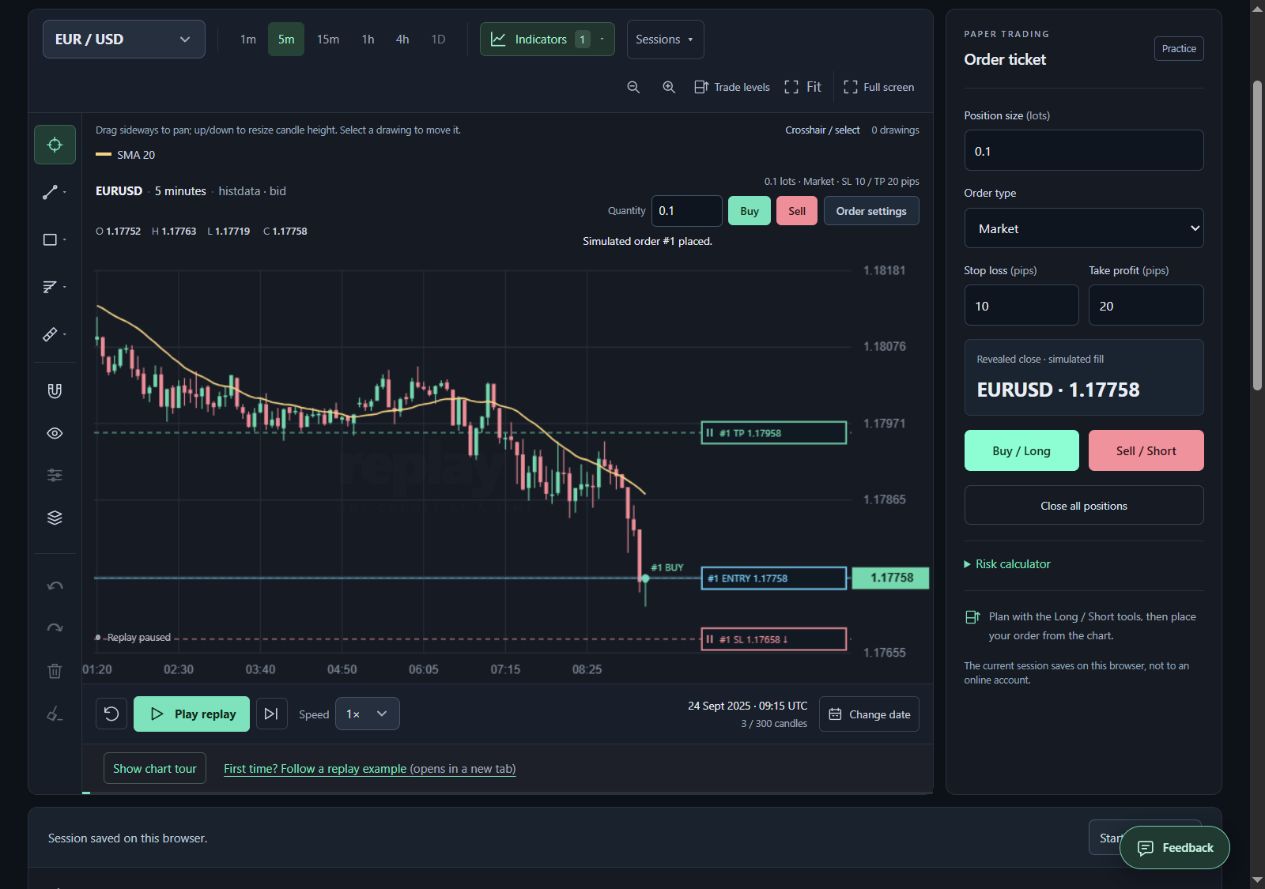
Historical replay can help you study decisions without seeing the next candles. ReplayPip supports simulated practice, but its results exclude trading costs and do not reproduce every aspect of broker execution. A positive backtest does not prove future profitability or mean you should commit the money you have saved. If practice increases pressure to deposit, take a break.
Be careful with funded-account shortcuts
An advertised funded-account balance is not necessarily money transferred to you or placed under your ownership. Before paying for an evaluation, establish whether trading is simulated or live, which fees you can lose, how drawdown and loss limits work, the conditions for payouts and refunds, whether resets cost more and which legal entity you are contracting with.
Belgium’s FSMA has warned about risks associated with online prop-trading challenges, including paid evaluations and demo-account arrangements. Providers differ; read the specific contract rather than relying on promotional headlines. Do not borrow to pay challenge fees. Several unsuccessful attempts can consume months of savings. This article does not recommend any provider.
Other people’s money brings other responsibilities
Asking someone to finance personal trading differs from earning money through work. A friend saying “trade this for me” does not remove the possibility of losses, disputes or legal obligations. Depending on the country and arrangement, raising or managing money from others may involve financial-services rules.
Do not promise guaranteed returns, collect deposits from followers or present demo results as proof that you can safely manage someone else’s savings. Seek qualified local advice before considering other people’s funds. Pooling money or calling it a gift is not a substitute for understanding the actual arrangement and its obligations.
Your fund does not need a deadline
Someone else’s account balance says little about what is affordable for you. You do not need to match their deposit, replace your salary or turn a small account into a large one by a particular date. Increasing leverage to compensate for limited capital increases the consequences of adverse price moves.
A funding plan should establish what you can genuinely afford to risk. Sometimes that is a small amount; sometimes it is nothing. Build from earned income, protect essential expenses, keep emergency money separate and never borrow for speculative trading. Learning can continue while savings stay outside the market.
This article is general education, not personalised financial, investment, tax or legal advice. Syed Awais provides editorial direction as ReplayPip’s creator; no professional financial-adviser qualification is claimed.
Borrowing money to trade: when a trading loss becomes a debt