CURRENCY CONVERSION
How currency conversion works: rates, calculations and the history chart
A currency converter answers a simple question: approximately how much is this amount worth in another currency? The arithmetic is straightforward, but the result depends on the source, date and meaning of the exchange rate. Here is how ReplayPip’s converter calculates the estimate and how to read it.
Enter an amount and choose two currencies
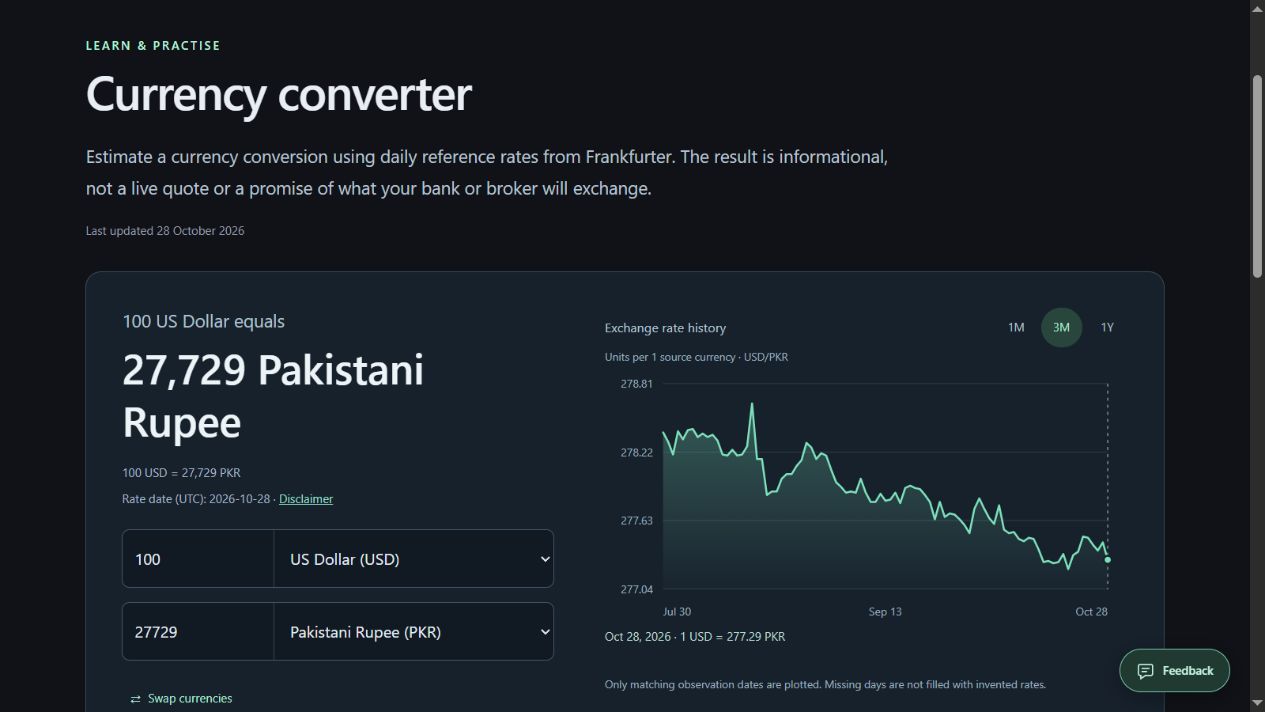
Open the currency converter, enter an amount in the first row and choose the source and target currencies. The second row and the large result update automatically. You can also edit the converted amount to calculate the equivalent source amount, or use Swap currencies to reverse the direction.
The fields, currency selectors and chart update within the page. There is no Convert button or page submission. Supported currencies and a bounded historical dataset are loaded from ReplayPip’s database when you open the page; your amount is not sent to Frankfurter. JavaScript is required for these automatic interactions.
Understand the rate before multiplying
If one US dollar corresponds to 277.29 Pakistani rupees in a stored observation, converting 100 USD gives 100 × 277.29 = 27,729 PKR. That is the dated example in the screenshot, not a claim about today’s exchange price whenever you read this article.
For a cross-rate, ReplayPip stores a common USD base and calculates amount × target rate ÷ source rate. As an invented arithmetic example, suppose 1 USD equals 0.90 EUR and 0.75 GBP. Converting 120 EUR gives 120 × 0.75 ÷ 0.90 = 100 GBP. These two example rates are illustrative, not market observations. Choosing the same currency returns the original amount.
Where our reference data comes from
The converter uses Frankfurter’s blended daily reference rates, assembled from central banks and official sources. It is not a broker bid/ask feed or a tick-by-tick price stream. The selected fiat currencies shown in ReplayPip are a subset of the provider’s coverage.
Our server checks the latest rates every six hours through the scheduler. That checking frequency does not turn a daily reference rate into a six-hour or live market quote. The source link below explains Frankfurter’s data and API; it is not an endorsement of ReplayPip.
Read observation dates separately from download time
Rate date identifies the stored observation used in the calculation. Last successful check tells you when ReplayPip last downloaded a valid snapshot. They answer different questions: a successful check can return a rate already published on an earlier date.
Two currencies can have different observation dates, especially around holidays or delayed publications. The converter displays both dates and a warning when it combines them. Older rates or delayed successful checks are flagged. If an update fails validation or the provider is unavailable, the last valid stored snapshot is retained rather than replaced with invented values.
What the history chart shows
The chart plots the target-currency value of one unit of the source currency. Changing your amount changes the conversion result, not the chart’s unit. For example, a USD/PKR chart shows PKR per one USD even when you enter 100 USD.
Use 1M, 3M and 1Y for the last 30, 90 and 365 days. Hover, tap or focus the chart and use the left and right arrow keys to inspect observations. Historical cross-rates use only dates where both currency observations exist. The line connects available points; missing days do not gain fabricated observations.
History is initially loaded for one year, and the recent week is refreshed daily. Daily observations cannot show intraday fluctuations. The historical series and latest conversion snapshot may differ because they are updated separately. An empty period is labelled rather than filled with sample prices.
Why a bank or broker may show another amount
A reference conversion excludes bank spreads, transfer charges, broker pricing and execution conditions. Those can change the amount actually received. The headline uses the target currency’s configured display precision, while the input rows and detailed conversion can show up to six decimal places. A very small result can round to zero.
For a transfer or exchange, compare the provider’s actual quote, charges and amount to be received. ReplayPip’s converter is an informational estimate. It does not execute a payment or reserve an exchange rate.
Keep conversions separate from backtesting
The converter does not change historical candles, simulated account balances or profit calculations in ReplayPip. Converting an amount with a recent reference rate is not the same as reproducing a historical trade’s currency conversion at its execution time.
Use the converter to explore approximate currency equivalents, and use the data and methodology page for the replay engine’s own assumptions. Neither a conversion result nor a historical chart establishes a trading opportunity or future return.