TRADING PSYCHOLOGY
How to manage trading emotions and build trading discipline
A losing trade can make the next entry feel urgent. A winning streak can make a larger position seem justified. The useful goal is not to stop feeling anything; it is to notice when a feeling is about to change a decision you already planned. This guide offers a practice routine for that moment. Emotional discipline can support a consistent process, but it cannot make an unprofitable strategy profitable by itself.
Start with the difference between discipline and an edge
Following rules consistently makes a strategy easier to evaluate. It does not establish that the rules have an advantage. You also need evidence from a suitable sample, realistic costs and execution assumptions, and a way to assess losses and uncertainty. A profitable practice session is not enough.
Consider an invented example: 40 wins of 2R and 60 losses of 1R produce +20R over 100 trades, or +0.20R per trade before costs. If average costs were 0.25R per trade, the net average would be −0.05R. Here R means the planned loss if the stop executes as assumed. Calm execution would not repair this negative result; live losses can also exceed planned R.
Name the trigger before placing another order
Treat these as prompts for observation, not diagnoses: FOMO may sound like “I missed it; I must enter now.” Revenge trading may sound like “I need to win back that loss today.” Overconfidence may sound like “The last three won, so I can ignore the limit.” Fear may appear as repeatedly skipping valid practice setups after a loss.
Write the exact thought and the action it encourages. “Frustration after a stop; urge to double the next position” is more useful to review than “bad psychology.” MoneySense describes how overconfidence and following the crowd can affect investing decisions; its general guidance does not validate any particular forex strategy.
Write a decision card before the session
Choose one instrument and a defined practice window. Record the setup, entry condition, invalidation, planned exit and simulated position-size rule. Add what makes the session stop. The card should let you decide whether an action fits without looking at the next candle.
Example practice card: keep the same simulated size for this exercise; do not move a stop farther away to avoid accepting a loss; if I take an entry outside the written setup, pause and document it before continuing. These are illustrative process rules, not a recommendation for a particular live risk amount.
Use a pause that interrupts the next action
When you notice the urge to recover a loss or chase a move, pause the replay before placing another order. Read the decision card, write the trigger and check whether the next setup actually qualifies. Waiting is a valid decision when it does not.
A five-minute break is one possible practice convention, not a scientifically established cure. Decide your pause rule in advance rather than bargaining with it after a loss. In live markets a pause does not close positions or cancel orders; their risks remain until handled separately. Never assume stopping the chart removes exposure.
Practise an unfamiliar period without rewriting the outcome
In ReplayPip, select an available date, write the plan, then reveal candles one at a time. Before each simulated entry, record the reason and an urge rating such as 0–5. The scale is your own observation tool, not a clinical measure. After the trade, record whether you followed the plan, even if breaking it happened to make money.
Keep the first complete record. Do not reset a losing sequence until it looks good and count only that attempt. Repeating a known date may help interface practice, but it is no longer an unfamiliar test. Replay also lacks the financial pressure, trading costs and execution conditions of a live account.
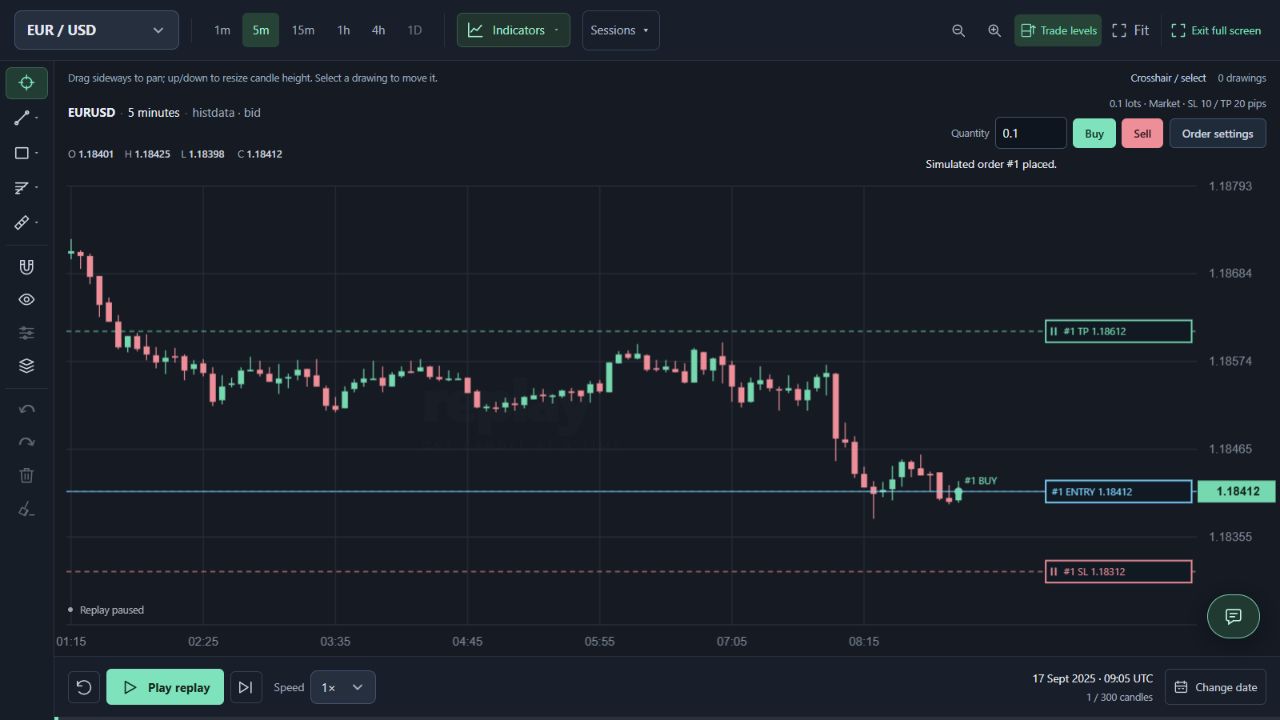
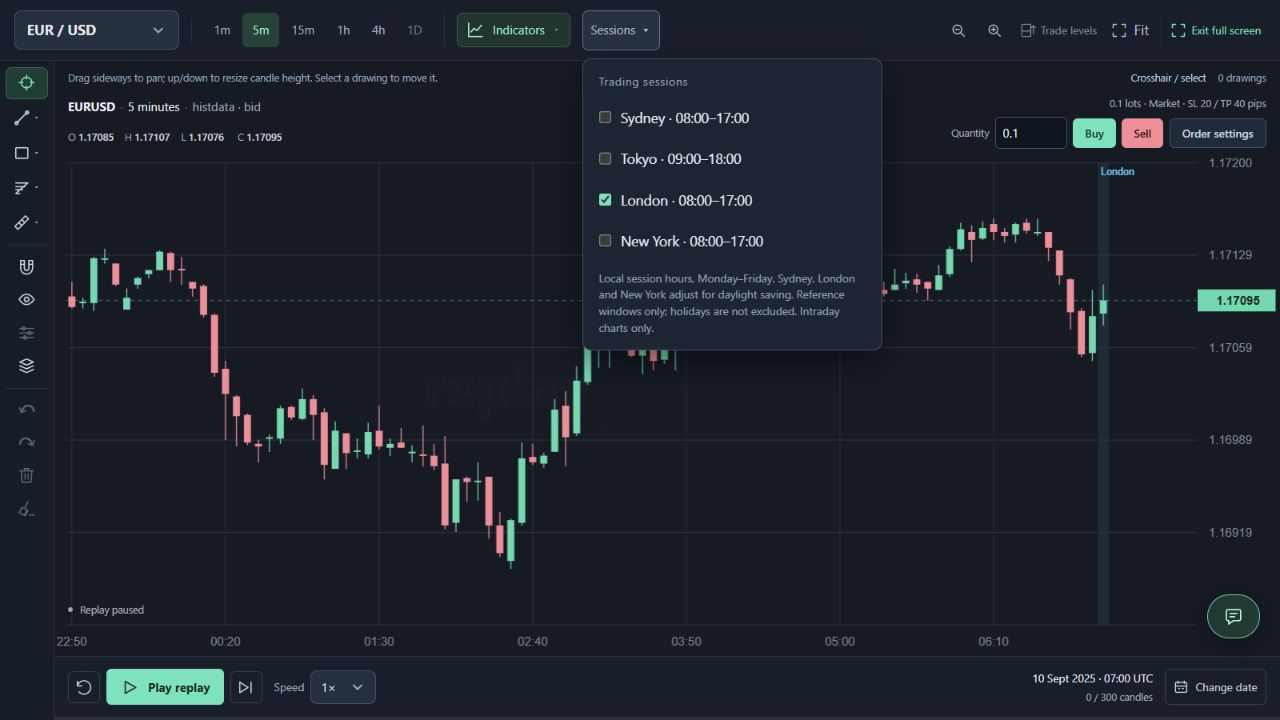
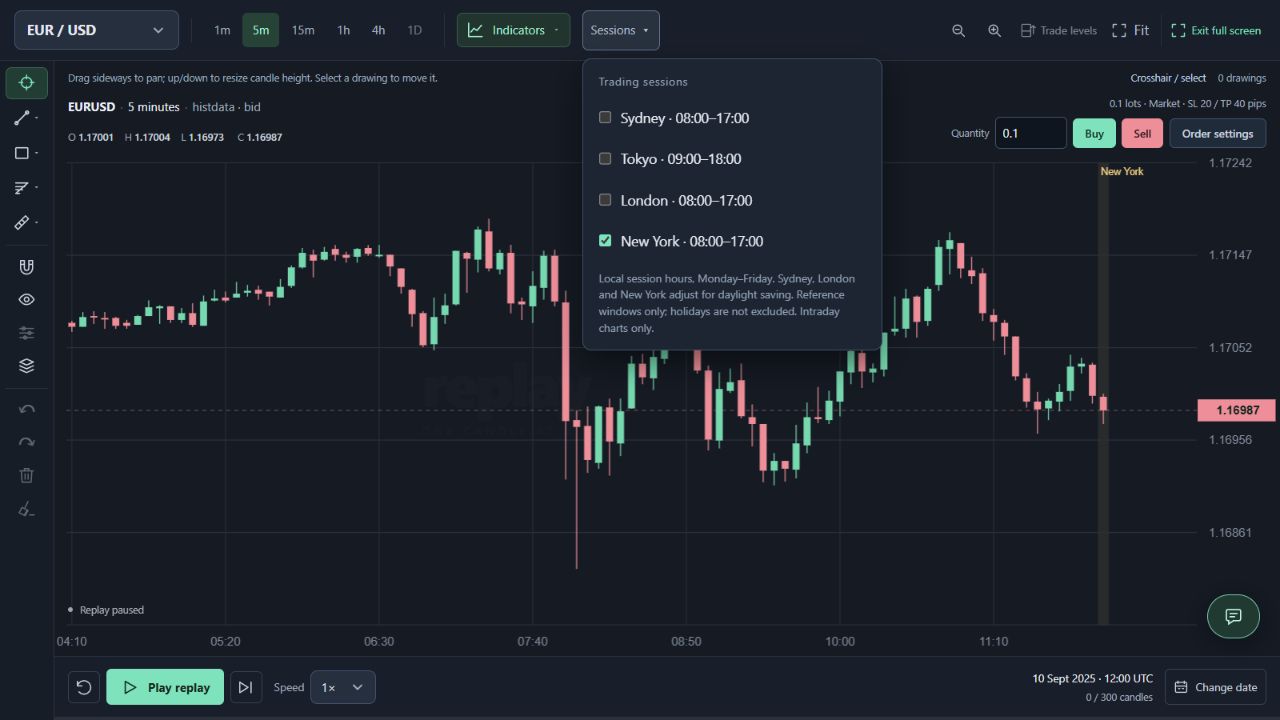
EUR/USD replay case study: a recorded trade from plan to exit
Keep a journal that can separate behaviour from results
Suggested fields: date and instrument; strategy version; setup present or absent; planned size and exit; trigger and urge rating; action taken; rule followed or broken; simulated result; and one observation for the review. Save it outside the browser as well. Browser session storage is not a permanent journal backup.
Example entry: “After a losing trade, urge 4/5 to increase size. Paused, kept the planned size and skipped an entry without the setup.” That is an invented example of a useful record. It does not claim the next trade won or that this routine improves anyone’s returns.
Review process and profitability as separate questions
At a stopping point chosen before practice, compare qualifying decisions with your written rules. Track how often you changed size, chased an entry or moved an exit outside the plan. A higher rule-following rate is a process observation; it is not evidence of a profitable edge.
Separately examine the complete strategy sample, losses, costs and results on another period. If the rules need changing, save a new version and test it separately. Do not label every loss an emotional mistake: a correctly followed plan can lose, and a broken rule can win by chance.
Know when more trading is the wrong next step
If you feel unable to stop, are borrowing to recover losses or are using money needed for daily life, step away from trading and seek appropriate independent support. More replay sessions are not a substitute for help with financial distress or compulsive behaviour.
Investor.gov warns that fast, leveraged day trading can involve substantial losses and emotional pressure. Its discussion concerns securities; forex products have their own local rules and risks. Use this article as an educational practice framework, not a promise of profitability, personalised financial advice or psychological treatment.