SIMULATION BASICS
Backtesting vs live trading: why replay results differ
The trades table gives an exact-looking number. That does not mean the simulator knows every price movement inside the candle. Understanding the fill rules helps you use a result for what it actually describes: an outcome under ReplayPip’s assumptions, rather than a reconstruction of an order sent to a broker.
A candle is a summary, not a sequence
Imagine a candle opens at 1.10000, reaches 1.10450, falls to 1.09750 and closes at 1.10100. The same OHLC values also fit a path that visits the low before the high. For a position with a target at 1.10400 and stop at 1.09800, those paths imply different exits. One-minute data narrows the time window; it still does not tell us the tick-by-tick ordering within that minute.
What ReplayPip does with that ambiguity
If both exit levels are touched in a later candle, ReplayPip processes stop loss first. It does not choose the target because that would make the result look better. This is a conservative convention, not evidence that the stop happened first in the market. For a pending entry triggered inside a candle, the simulator evaluates the candle’s full range with the same stop-first convention. Note that assumption when an entry and exit happen within one candle.
A market entry is the revealed close
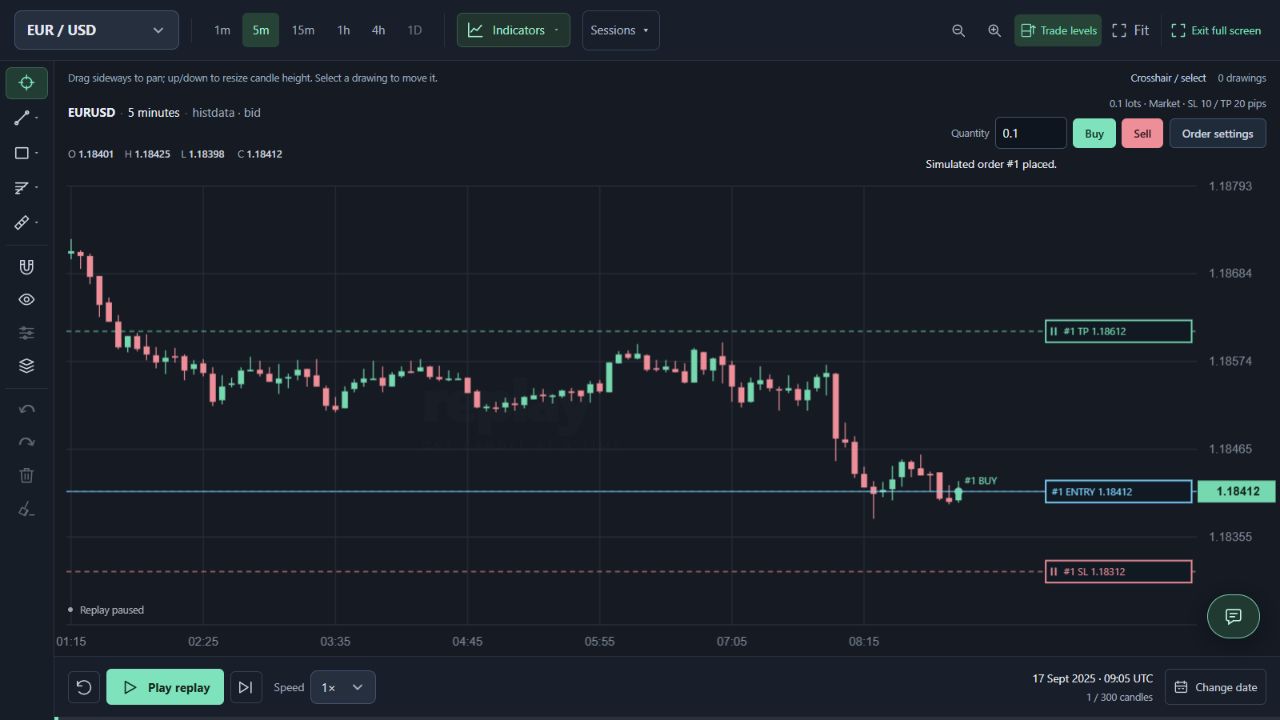
The Buy and Sell buttons create simulated market positions at the current revealed close. They do not obtain a fresh broker quote. Stop and target processing starts on subsequent candles. If the next candle opens beyond an exit level, the simulator uses that opening price for a gap fill. The risk calculator’s planned amount therefore is not a guaranteed loss limit, even under the simulator’s own rules.
The price basis and missing costs matter
Check the source and price basis above the chart. HistData candles in this platform use bid prices; Binance spot candles use traded prices in USDT. They are not a bid-and-ask execution model for your account. ReplayPip omits spread, commissions, slippage, financing, leverage and margin checks. If you keep a separate cost estimate in a journal, label it as an assumption rather than presenting the simulator’s price-only figure as a net broker result.
Check the current dataset coverage on our data and methodology page before comparing a replay result with a broker statement.
Use the result to ask a better question
Instead of asking “would I have earned this?”, first ask whether your rule was clear enough to apply before the next candle appeared. Compare different periods without changing fill assumptions between them. Flag trades where one candle touched several levels, and check whether your conclusion depends heavily on those cases. Read the methodology alongside the result. Replay is useful for examining decisions; it cannot turn an OHLC summary into proof of an executable live outcome.
Keep a record you can review with the forex backtesting journal template. Copy the fields into your own spreadsheet before resetting the replay.