SESSION PRACTICE
London session backtesting: a manual EUR/USD replay exercise
A London-session backtest needs a time rule as well as an entry rule. This walkthrough shows how to choose a reference window, hide the outcome and review a hypothetical setup in ReplayPip. It does not establish that a London breakout strategy is profitable.
Choose the London reference window
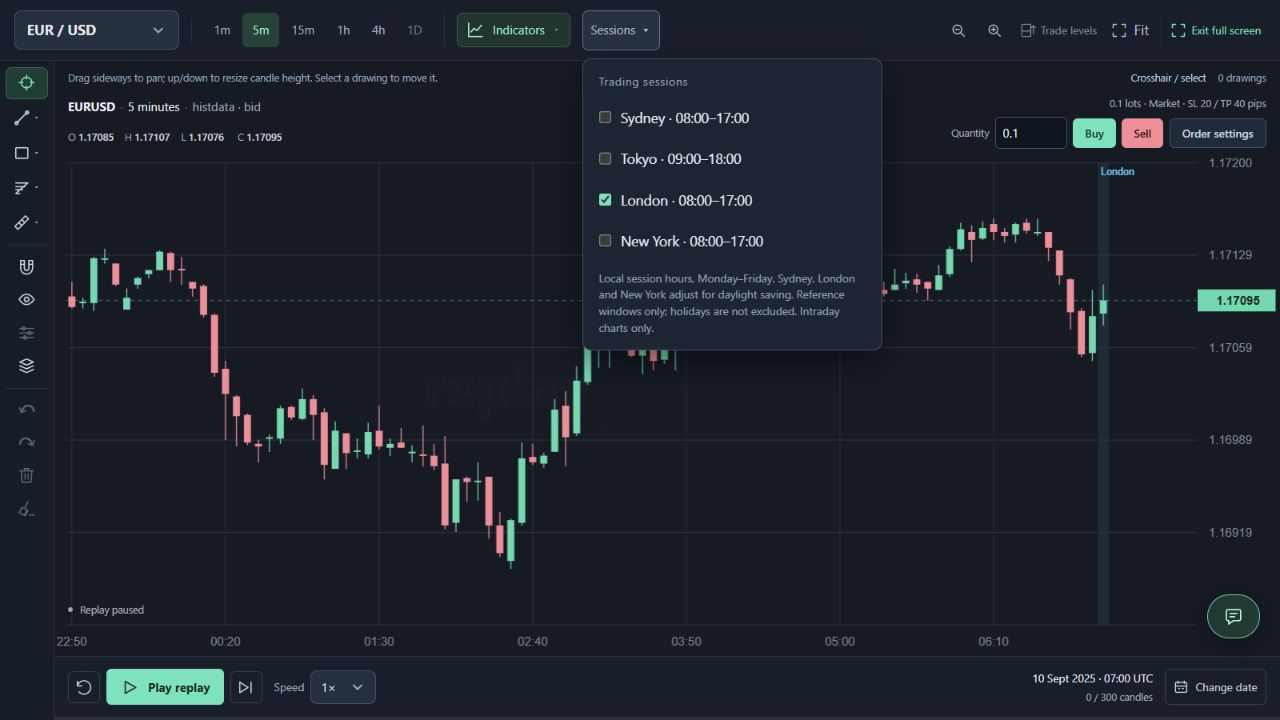
Open EUR/USD, choose an available historical weekday and pause the replay. On an intraday chart, open Sessions and select London. ReplayPip uses 08:00–17:00 in Europe/London, adjusting for daylight saving time. This is an application reference window, not an exchange opening bell; holidays are not excluded. The chart clock remains UTC.
Keep local hours and UTC separate
The screenshot uses 10 September 2025: 08:00 in London is 07:00 UTC. In winter, 08:00 London is normally 08:00 UTC. Use the offset for the historical date, not today’s offset. Write both the local session and UTC date/time in your journal. For this exercise, define a smaller observation window of 08:00–10:00 London time and start before it to inspect earlier candles.
Write a rule before revealing the next candle
One hypothetical rule is to mark the high and low of the preceding hour, then consider only the first five-minute close above that high during the observation window. Specify a stop, target, maximum number of attempts and a skip condition in advance. For example, skip if the planned stop exceeds your written limit. This is a rule to investigate, not a recommendation to trade breakouts. Do not move the range after seeing the outcome.
Work through an illustrative order
Suppose a qualifying close is 1.10000, your planned stop is 1.09850 and your target is 1.10300. The distances are 15 and 30 EUR/USD pips: a planned 2:1 ratio. At 0.10 lots, the simplified price risk is 10,000 × 0.00150 = 15 USD before costs and gaps. These invented levels are not the screenshot’s prices. Use the actual revealed close and your own written levels; Buy / Long fills at that revealed close, while Pending entry is for an unreached entry price.
Reveal and record without rewriting the plan
Use Next candle to advance. Record the initial levels, any adjustment, the exit reason and whether the rule was followed. A candle touching both SL and TP is processed stop first. HistData uses bid prices; the simulation excludes spread, commissions and slippage, so the number is not a broker execution result. Save an external journal even though the current session can restore locally after refresh.
Repeat across dates and keep a separate evaluation period
Record skipped opportunities as well as trades. Keep the same rule version across several dates, including losing examples, before making a change. If you revise the rule, evaluate it on another period you have not used to choose the settings. Compare decision quality separately from simulated profit. One screenshot, one session or a favourable reward-to-risk ratio cannot demonstrate a reliable edge.
Keep a record you can review with the forex backtesting journal template. Copy the fields into your own spreadsheet before resetting the replay.