TRADING RESEARCH & PRACTICE
Why consistent trading profitability is difficult: beyond the winning screenshots
A profitable trade is easy to recognise: you close it with more money than you started with. A profitable method is much harder to establish. Perhaps you have had a good week, followed by a loss that erased it. That does not automatically mean you lack discipline. The rules themselves may have no useful advantage after costs. Before asking how to join the profitable minority, ask what evidence would show that your method deserves confidence.
What the loss statistics actually tell us
In March 2018, ESMA reported that national regulators’ analyses across EU jurisdictions found 74–89% of retail CFD accounts typically lost money. This is historical evidence about those products and accounts, not a current worldwide success rate for every kind of trading. CFDs are leveraged derivatives; the findings cannot simply be applied to every share investor or every person who trades currencies.
The remaining accounts are not proof of a permanently profitable group. A reporting period cannot establish a lifetime track record. One person may also have multiple accounts. Avoid headlines claiming “only 1% succeed” unless the research, market, period and definition of success are identified. The useful lesson is that losses are common in retail CFD trading, not that a single percentage predicts your future.
Define profit before measuring it
A screenshot of one winning position leaves out the losing trades, money added to the account, costs and time spent. A deposit increases your balance but is not trading income. Keep deposits and withdrawals separate from trading results, and reconcile your journal with statements when reviewing a live account.
Write down what you are measuring: gross trading profit, profit after execution and financing costs, drawdown, or money available after any applicable tax. Those are different figures. A positive result over one month does not show that the approach can cover living expenses or survive a different market. This article discusses evaluating trading results, not replacing employment income.
A 60% win rate can still lose money
Consider twenty hypothetical completed trades. Twelve win $50 each and eight lose $65 each. Before costs, the result is $600 minus $520, or +$80. If the assumed average all-in trading cost is $5 per completed trade, total costs are $100 and the net result is −$20. These amounts are teaching assumptions, not representative broker charges.
The arithmetic per trade is (0.60 × $50) − (0.40 × $65) − $5 = −$1. In this simplified model, a win rate of about 60.9% would be needed merely to break even, assuming the same average wins, losses and costs. Actual costs vary; do not subtract spread twice if your recorded fills already include it. A high win rate alone says very little about profitability.
| Calculation | Contribution / result |
|---|---|
| 12 × $50 | +$600 |
| 8 × $65 | −$520 |
| 20 × $5 | −$100 |
| 60% | −$20 |
A backtest can look convincing for the wrong reasons
Imagine testing a rule on January, changing its stop after seeing a loss, then presenting the improved January result as evidence. You have used the same observations to design and judge the rule. That does not establish how it would have performed on unseen prices. Trying many variations makes it easier to discover a flattering historical result by chance.
Freeze one version before an evaluation period. Record every eligible setup, including losses and skipped trades. Keep a separate period that you did not use to choose the rules, and include different conditions rather than only a strong trend. A small positive sample remains uncertain; there is no magic trade count that proves a durable edge. Testing can reveal weak assumptions without creating a profitable strategy.
How to test a trading strategy change without moving the goalposts
Position size changes the consequences, not the evidence
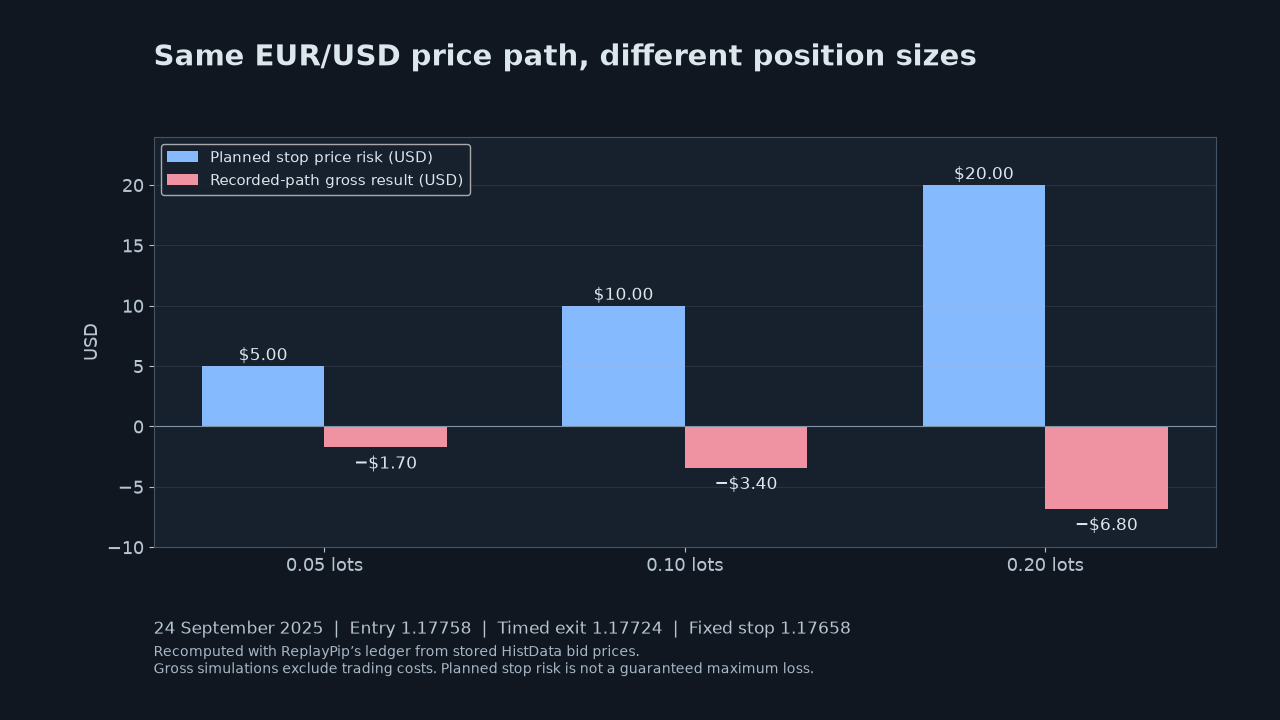
If a method loses money on average after costs, a smaller position does not turn that average positive. It reduces the monetary consequences under otherwise unchanged assumptions. Increasing size after a losing run can make the next adverse move much more damaging, especially when leverage is involved.
For example, a $1,000 account losing $200 falls to $800. Returning to $1,000 then requires a 25% gain on the remaining balance, not 20%. A stop order does not guarantee a precise exit during a gap or fast market. Never borrow for speculative trading, and keep rent, bills and emergency money outside the account. Choosing not to trade is a valid decision.
Borrowing money to trade: when a trading loss becomes a debt
Use a review sheet that can disagree with you
For each test, record the rule version, instrument, timeframe, dates, entry condition, planned exit, position size, outcome before costs, cost assumptions and any data or execution ambiguity. Review the largest loss and the worst sequence, not just the total profit. If one exceptional winner creates nearly the entire result, record that dependence rather than treating the average as routine.
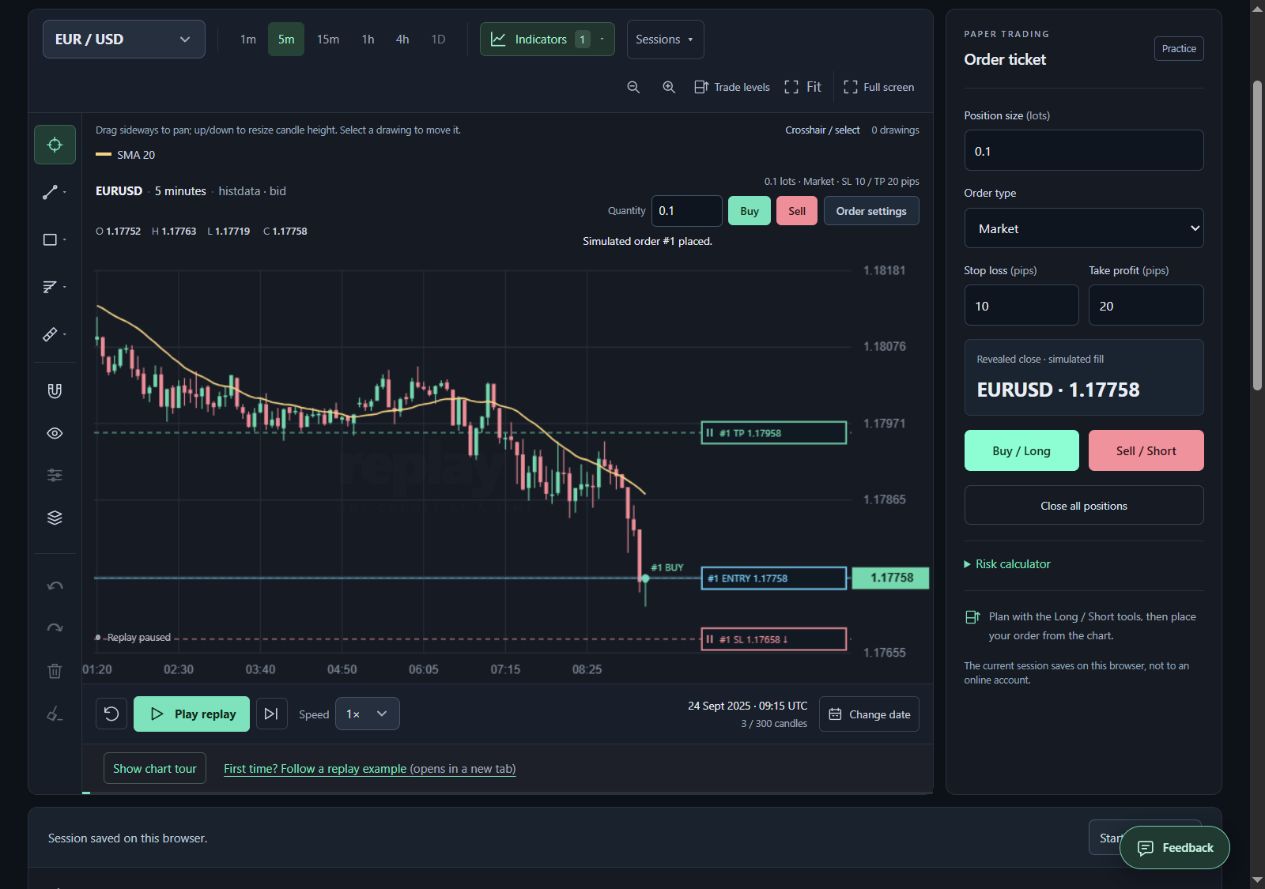
Compare repeated tests using the same definitions. Decide in advance when you will review a rule so that one frustrating trade does not trigger a redesign. If evidence remains weak, pause or keep studying without real money. ReplayPip can help organise historical replay, but its simulated results exclude trading costs and cannot reproduce all live fills, slippage or emotional pressure.
The goal is a more honest decision
Do not interpret a profitable minority as a promise that enough persistence will make everyone profitable. Learning, testing and keeping records can improve how you assess a method; they cannot guarantee income. Equally, a losing result is useful information rather than a reason to increase the next stake.
Before committing money, ask: are my results complete, have I allowed for costs, did I test unseen periods, and can I afford the loss without affecting essential commitments? If the answers are unclear, more confidence is not the missing ingredient. Better evidence, a pause, or deciding against live trading may be the appropriate next step.
General education only, not personalised investment advice. Syed Awais directs ReplayPip’s editorial work as its creator; no professional financial-adviser qualification or profitable live trading record is claimed.